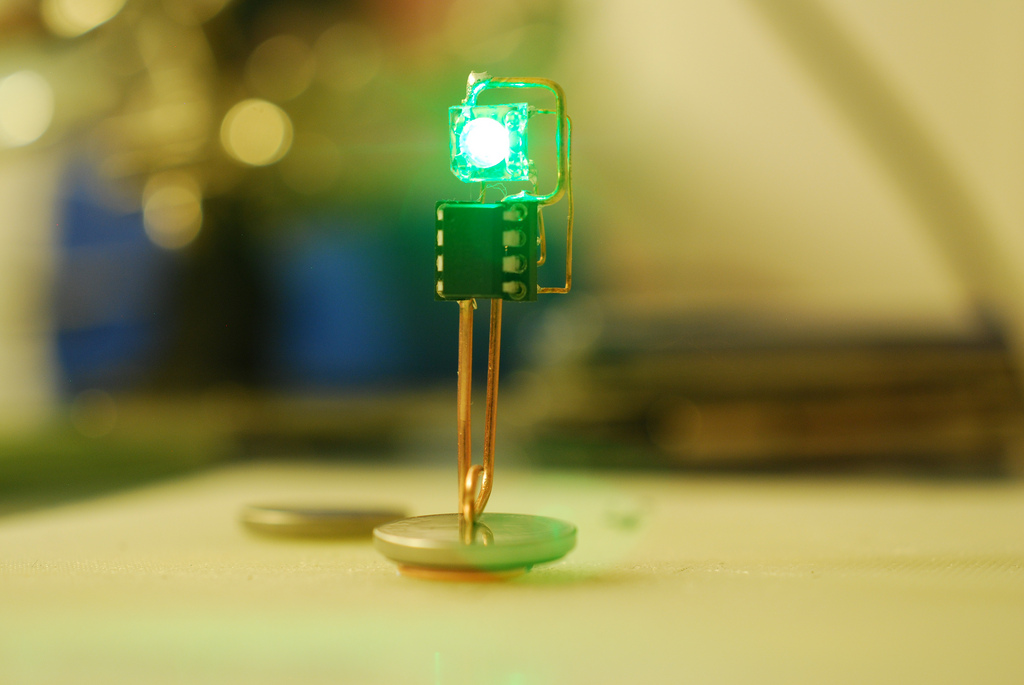
Photographer Jacob Sutton filmed snowboarder William Hughes wearing a suit covered in LEDs. By reducing the the aperture, the Sutton removes Hughes from the environment and forces the viewer to focus only on the movements of the rider.
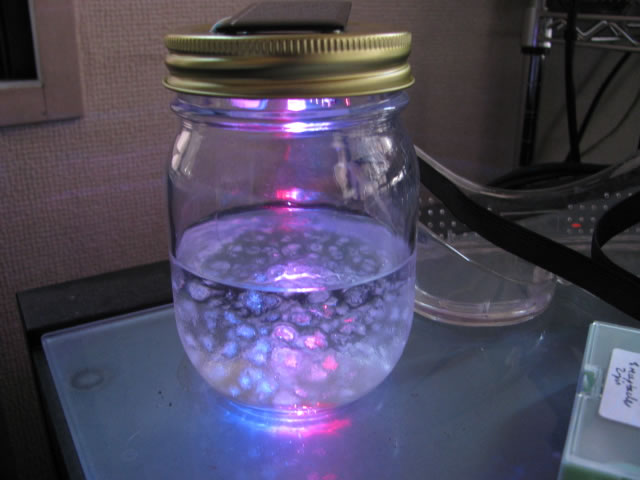
TokyoHakerSpace’s Kimono Lamp looks a lot like a DIY version of the €35 Marmaled / Jelly Lamp from Semiki, but more technically advanced. (The Marmaled uses a tilt switch and two AAA batteries.) Really, when it comes down to it, the Marmaled’s jar and black label is what sets it apart. Of course, you can always buy jars wholesale
Video of the Kimono Lamp in action after the jump.
d&@le Concepts concepts (nomme de art for Alessandro De Ambrogio and Carlos Basanta) have created the GUL Two, a solar powered LED plant that lights up at night. Currently installed at in the Elemental Gardens at Pacific National Exhibition in Vancouver.
Looking at the photos of the air quality balloons, I thought of how they resembled sky lanterns, the small hot air balloons popular in parts of Asia. (The “trick” is fire proofing the paper.) I would like to make one of these, but living in California, I’m afraid they’d turn into fire balloons. Yes, a nonflammable equivalent could be made with Helium and some LEDs, but it doesn’t seem the same. The simple elegance of a bag and a flame is part of the attraction of the lanterns to me.
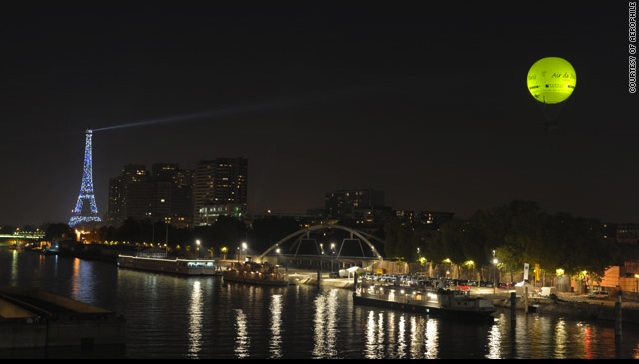
“Tethered balloon specialists”, Aerophile, a European balloon company, has installed a glowing balloon over Paris to inform Parisians of the local air quality. Named Air de Paris and located in the Parc Andre Citroën, the balloon relays data from sensors deployed throughout Paris as part of the CITEAIR project.
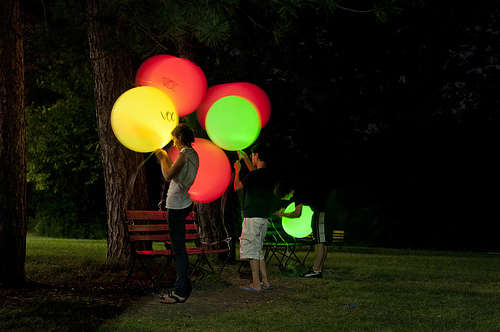
This work draws an obvious comparison to the work of Stacey Kuznetsov, a student in Eric Paulous‘s lab at CMU. Her Air Quality balloons, integrated a air quality sensor along with RGB LEDs directly into a weather balloon, to provide local, rather than regional air quality information. I have no idea of Aerophile contacted Stacy Kuznetsov, or what, but the idea of local information.
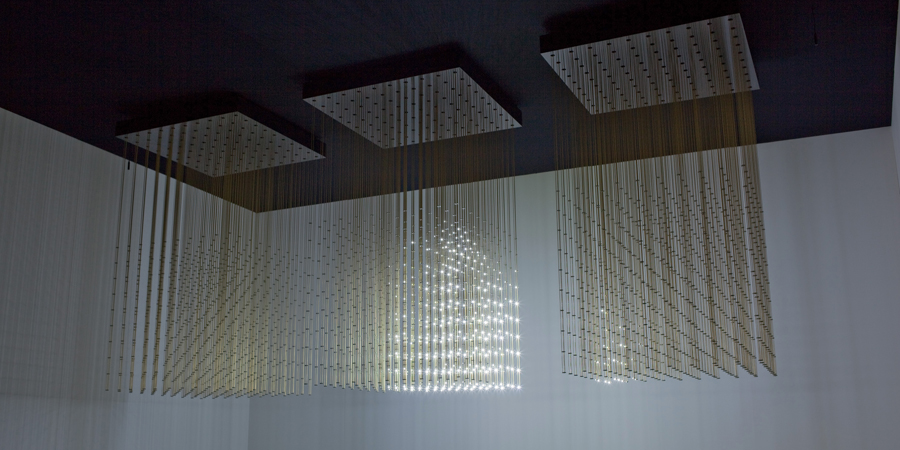
rAndom International unveiled xhibited “Swarm Light” (video and detail photo after the jump) at Design Miami / Basel last month. The installation consists of the three cubes of white LEDs. The LEDs are lit according to a flocking algorithm, and move in three dimensions around the cubes. Viewers can interact with the light by standing under the different cubes and by using sound to “scare” flock.
Jim Blackhurst’s SmartLED SolarTherm is a minimalist information display. Consisting of an RGB LED, a watch, and an ATTiny25 microcontroller. The chip contains a temperature sensor whose reading is displayed as light pulses. According the comments on Makezine, the internal temperature sensor is +/- 10 C (+/- 18 F), so its not very useful.
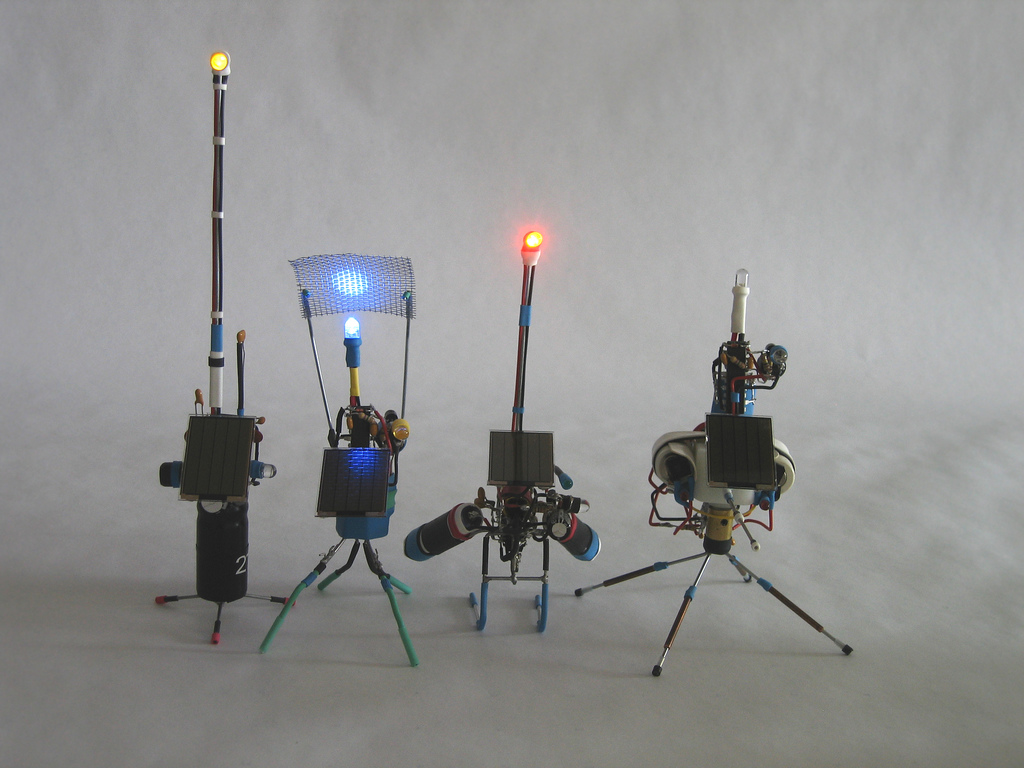
SolarTherm is simpar to M27′s Zach DeBord’s pummers. These charge a capacitor from a solar cell, and when the light level drops, the capacitor discharges, and causes an LED to blink.
While as an ambient displays these are visually interesting, especially Zach DeBord’s pummers, these seem to suffer from the main problem with all ambient displays. They trade simplicity for usefulness.
I want the display to be both pretty, but also informative. The display needs to be immediately interrogated. Similar to the how a grandfather clock provides a chime ever 15 minutes to an hour, but also can be viewed in order to learn the exact time. I’m thinking of something like Riedi and Gloor’s Weather Diorama.
Things like Nabaztag or the infinitely more endearing, Michael Kaminsky and Paul Dourish‘s SWEETPEA (aka “The Microsoft Barney Paper”) are more confusing than anything. Even baseball signs aren’t that confusing.
Maybe the best ambient display I’ve seen was simply a string hanging from a DC small motor wired directly into an ethernet cable. As packets would pass, the motor would be powered, causing the string to wiggle. As the network activity increased, so would the vigorousness of the string’s dancing. The great thing about this display is that it’s immediately and intuitively interpretable, while something more complex requires the user to learn some of sign language.
Spanish art collective, Luzinterruptus latest creation, Jardín para un Futuro, No Muy Lejano (Garden for a Not Too Distant Future), is 110 clear plastic containers, each containing a few leaves and branches, along with a green LED.
The artist statement says that installation was a humorous statement about the lack of green space in modern cities; but given the frequency of their installations, I think that’s more just talk than anything.
Alex Schlegel‘s Day Table uses a photoresistor located in one corner, and eight ShiftBars (for a total of 24 channels) connected to an Arduino to play back the sunlight that fell on the table during the course of the day.
Macetech built this table to demo their shiftbrite RGB LEDs and a Seeeduino. It’s a 9 x 9 grid, but since each LED has its own controller, the cost quickly climbs.
While not a table, Dave Clausen‘s LED Cylinder is a good resource for discussing how to wire up set of addressable RGB LEDs, along with some good resources to parts and the like.
Recently I’ve been thinking about a LED displays. Originally, I was thinking about a full 640 x 480 display, but after doing the math, that idea quickly shrank to a more manageable 32 x 24 display. While part of me thinks that having one of these tables would be interesting, I can’t help but think that in reality they’d just be ugly and too bright.
I started to think about LED displays because my “coffee table” (It’s actually more an end table.) has a glass top and holes cut out in the back for electrical cables to pass through. What I really want is a multitouch display like either of these twoguys are building. However, a multitouch is still pretty hacky and more DIY than I want right now. I like the idea of owning one of these tables, I just don’t want to build it.