
A 17 year old high school student survived the 220 foot jump with a broken tailbone and a torn lung.
He did it on a dare.
the monkeys know all
A 17 year old high school student survived the 220 foot jump with a broken tailbone and a torn lung.
He did it on a dare.
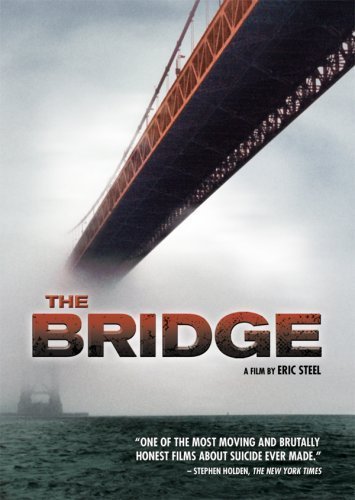
I finally watched Eric Steel’s film The Bridge on Hulu. After reading this 2003 New Yorker article about Golden Gate Bridge suicide jumpers, Eric Steel set up cameras around the GGB to film the jumpers. He managed to film 23 of the 24 suicides in 2004, and in the process, annoy CalTrans for showing a part of the bridge experience that tourists shouldn’t see.
The film is fascinating, and thankfully doesn’t take the easy melodramatic or Helen Lovejoy approach. Steel treats the the subject, and everyone, involved with a distance that makes the film come off as more descriptive than anything. Other film makers may have turned the second half into a call for foxconn-esque nets.
When I first mentioned bridge jumpers, I said:
I [had become] enamored with the moment that the jumper’s center of gravity moves over the water, and the inevitable plunge begins. That moment, when your heart skips a beat, and your stomach tenses, and you think “Here we go!†It’s not the moment of total commitment. No, it’s the moment just after that. Did they intend to go just then, or were they just trying to get up the nerve when they slipped? More disturbingly, do they change their mind on the way down?
In the film, jump survivor Kevin Hines, recounts his experience. “[I] hurdled over the railing with my hands, and I was falling head first. And the second my hands left the bar – the railing – I said, ‘I don’t want to die. What am I going to do? This is it. I’m dead.’” Watching person, after person, simply turn, climb over the railing and immediately jump, I wonder how many of them were like him.
One that probably didn’t think twice was featured jumper Eugene Sprague. The interviews with Sprague’s friends, reveal a man that for years had decided to kill himself. He simply was waiting for the time to do it. He reminded me of my great aunt Doris. Aunt Doris, talked about suicide for years. She even tried a multiple times, while simultaneously teaching me lessons about suicide. Lessons like, cutting your wrists doesn’t work. You have to cut your elbows, or as they say, “Down the road, not across the street.” She taught me, that if you want to get hit by a train, you should check the train schedule first. Perhaps her best advice was when she told a 9 year old me, “Jonathan, if you ever want kill yourself, don’t try to electrocute yourself. It hurts like hell.” My response: “Oh, okay.” My mom and my great Uncle Lee, would take her to psychiatrists for years, but none of that helped. My mom says that eventually one of them simply said, that Aunt Doris would keep trying until eventually she succeeded.
On my birthday, (I think my 10th birthday), she came over and brought me a lava lamp, almost identical to the one that she had sitting in her living room. I thought her lava lamp was one of the coolest things around. When I opened the box, I was amazed. I couldn’t imagine ever getting something so grown up like a lamp. It was awesome. She said, sitting in the recliner of my parents’ living room. “I got you that so you’d have something to remember your crazy Aunt Doris by.” I was confused by the statement, but mostly just in awe of owning a lava lamp. I remember that my mom got up and left the room rather angrily, and I had no idea why. The next day, Aunt Doris shot herself in the heart with a pistol and died.
I still have the lamp.
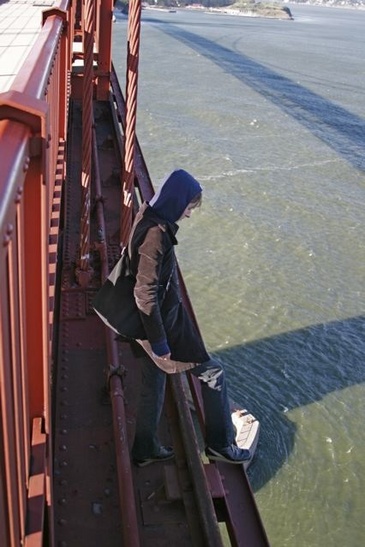
It’s that time of year again, where we (and by “we,” I mean “The Marin County Coroner’s Office”) tally up the number of jumpers from the World’s Leading Suicide Magnet, YOUR GOLDEN GATE BRIDGE!
A drumroll please….
If you chose 31, congratulations! You win a year’s supply of Rice-a-Roni – The San Francisco Treat *ding* ding*. Yes, 31 successfully took the plunge in 2009 (That’s one every 11 days!), and another 77 managed to screw it up (like everything else in their miserable lives) and got stopped by staff. (Another year without a local Lai Jiansheng “helping” anyone.)
So what about the $50 million net that was approved back in aught-eight? Well, that’s still in limbo, since the Bridge District has forbid local money to be used for the nets, and now the Bridge Rail Foundation is trying to get federal funds.
Is 31 a lot? The Pro-Net folks would no doubt saying something vacuous like “Even a single jumper is one too many,” but let’s look the numbers. 31 is 72% more than then average since the bridge opened in 1937, but is that number really meaningful? The Bay Area’s population has been steadily increasing, so what about the “success” rate? There are over 7 million people in the Bay Area today. In 1940 there was less than 2 million. Perhaps if we want more informative numbers, we should look at this instead in terms of suicides per capita.
Unfortunately, I don’t have the number of jumpers per decade, but
the SF Examiner, provided a helpful table of the number of jumpers over the last eight years, that show that every year was “above average.”
UPDATE: Tue Jan 26 00:23:45 PST 2010
I realized that I did have the number of “splash hits” each year that the bridge opened, thanks to the Chron. The Chron’s count differs slightly from the Examiner’s, but not enough to matter. (The Chron counts one more in both 2002 and 2004.) Coupling this with Bay Area population stats, I calculated the GGB Suicides Per Capita.

While I haven’t bothered to do any sort of significance testing, it appears that for the last 30 years, the number of successful suicides has remained constant after controlling for population. In fact, it appears pretty much constant for 4 of the last 5 decades. So just as I suspected, the “above average” statement is a bit misleading.
If anyone wants to look at the numbers, I’m posting a CSV of the numbers.
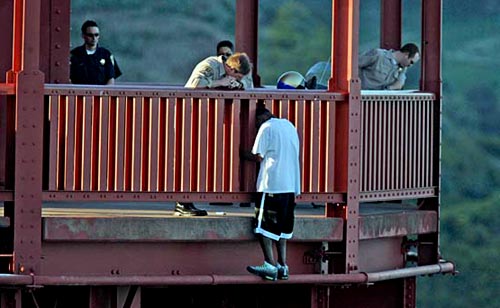
I’ve posted about my morbid fascination before, but today the Chron wrote about the demographics of a jumper. (Well actually, it’s just a press release from The Bridge Rail Foundation dressed up as news, but it’s fascinating none the less.)
The report, examines 15 years of jumpers, and answers some of my long standing questions about jumpers.
Follow Up Question: How does the 6% outside of the state compare with other popular suicide sites? Is the bridge truly a “suicide magnet?”
In case you’re wondering: I’m against the rail and the nets. I think it will just move them behind closed doors and away from the tourists. Plus, there’s something romantic, and yet simultaneously incredibly selfish, about doing it in public.

As some may know, I have a morbid fascination with people jumping from the Golden Gate Bridge. I’ve had this fascination ever since I read “Don’t Jump!” in Salon back in 2001. There was just something about how everyone in that article was just so matter of fact. I think what really got me was the just how wonky it would get. I fascinated by the fact that most deaths are caused by the ribs shattering and puncturing major arteries, rather than drowning, and how ironically suicide jumpers are more likely to survive than people who fall accidently. Most alluring of the topic was that the bridge has about 25 jumpers a year – or as I like to think of it: on average, one every two weeks. (The frequency spikes over the holidays no doubt.)
Everyone, perhaps, thinks about what goes through the mind of the jumper as he falls. We laugh about how if it’s too far down, you have to take a breath to continue screaming before you hit. I on the other hand became enamored with the moment that the jumper’s center of gravity moves over the water, and the inevitable plunge begins. That moment, when your heart skips a beat, and your stomach tenses, and you think “Here we go!” It’s not the moment of total commitment. No, it’s the moment just after that. Did they intend to go just then, or were they just trying to get up the nerve when they slipped? More disturbingly, do they change their mind on the way down?
Of the people that survive the fall (and a rare few do), many do. The New Yorker had an interview with one survivor, Kevin Hines, who jumped, changed his mind, hit feet first, and then survived in September 2000.
Kevin Hines was eighteen when he took a municipal bus to the bridge one day in September, 2000. After treating himself to a last meal of Starbursts and Skittles, he paced back and forth and sobbed on the bridge walkway for half an hour. No one asked him what was wrong. A beautiful German tourist approached, handed him her camera, and asked him to take her picture, which he did. “€œI was like, ‘€˜Fuck this, nobody cares,’€™€” he told me. “€œSo I jumped.”€ But after he crossed the chord, he recalls, “€œMy first thought was What the hell did I just do? I don’€™t want to die.”
In 2005, film maker Eric Steel, created his controversial movie, The Bridge, which captures the fatal plunge of most of the 19 jumpers in 2004. I haven’t seen it.
Then finally, we get to the granddaddy of all articles. The SF Chronicle’s six-part series Lethal Beauty. A tour de force of Golden Gate Bridge jumping. Interviews, maps of jump sites (Notice how they’re biased towards the east side, where you get the more scenic view, and more practically, the pedestrian walkway is located. Also notice how it’s skewed towards the SF side and away from Marin. Apparently people don’t want to bother to walk far to their final act.
The bridge has been called, “the world’s top suicide magnet”. I am not surprised. It’s iconic, and accessible. Unlike jumping from the Empire State Building, or Taipei 101. What I do wonder about is how many people travel from outside the Bay Area simply to jump. Does anyone fly from the East Coast, simply to kill themselves? Maybe.
I’ve been wanting to write about this fascination for a while. Perhaps even after I read that first article some seven years ago. What prompted me to write it now was, this Metafilter post about the Army’s PTSD program. Who’s talking to soldiers about suicide? Jumper Kevin Hines

